

UK passport holders can enter Vietnam without a visa for up to 45 days for tourism or business. For stays longer than 45 days, British citizens can apply for a Vietnam e-Visa online, which allows up to 90 days with single or multiple entry. The e-Visa costs $25 USD (single entry) or $50 USD (multiple entry) and takes approximately 3 business days to process.
UK Citizens Visa-Free Entry to Vietnam
Since 1 July 2015, British citizens holding a full British citizen passport have been exempt from visa requirements when entering Vietnam. This exemption applies to tourism and business visits.
Key conditions of the 45-day visa-free period:
– Maximum stay: 45 consecutive days per visit
– Purpose: Tourism or business only (not work or study)
– Entries allowed: Unlimited entries during the exemption period (leave and re-enter)
– Passport requirement: Valid British citizen passport with at least 6 months validity and 2 blank pages
– Applies to: All classes of British nationality except British National (Overseas) (BNO) passport holders
On arrival, your passport will be stamped with an entry stamp specifying the date by which you must leave. Check that the 45-day count starts from your arrival date, as immigration will not correct this after you leave the airport or border crossing.
If you plan to stay for exactly 45 days, you do not need any visa or pre-approval. Simply present your valid passport at immigration on arrival.
How to Stay Longer Than 45 Days
If you want to remain in Vietnam beyond 45 days, you have three main options:
Option 1: Vietnam e-Visa (90 Days)
The e-Visa is the most popular option for UK travelers who need more than 45 days. It allows a stay of up to 90 days with either single or multiple entry. The e-Visa is available to citizens of all nationalities and can be applied for entirely online.
| Feature | Single Entry e-Visa | Multiple Entry e-Visa |
|---|---|---|
| Fee | $25 USD | $50 USD |
| Maximum stay | 90 days | 90 days |
| Processing time | 3 business days | 3 business days |
| Validity | Single use | Unlimited entries within validity |
| Apply online | Yes | Yes |
You can apply for the e-Visa at the official Vietnamese government portal: evisa.xuatnhapcanh.gov.vn. Avoid unofficial websites that charge additional service fees.
Option 2: Visa on Arrival (Pre-Approval Letter)
UK citizens can obtain a Visa on Arrival (VOA) at Vietnamese international airports, but you must arrange a visa approval letter in advance through the Vietnamese Immigration Department or a licensed travel agency in Vietnam.
- Stay duration: 1 month or 3 months
- Entry type: Single or multiple entry
- Where to collect: Visa counter at your arrival airport (Hanoi, Ho Chi Minh City, Da Nang, Phu Quoc, Hai Phong, Da Lat, or Nha Trang)
- Requirements at the airport: Passport, approval letter, passport-sized photo, completed entry/exit form, and stamping fee (cash in USD)
The VOA is only available at airports, not at land or sea border crossings.
Option 3: Embassy Visa
For stays longer than 90 days or for specific visa types (work, study, investment), apply directly through the Vietnamese Embassy in London.
- Address: 12-14 Victoria Road, London W8 5RD
- Services: Tourist visa, business visa, work visa, transit visa, 5-year visa exemption
- Processing time: 5-7 business days (standard), 2-3 days (express)
The British Embassy in Hanoi will not assist with visa extensions. Contact the Vietnamese Immigration Department for extension queries.
How to Apply for a Vietnam e-Visa: Step by Step
Applying for a Vietnam e-Visa as a UK citizen takes about 15-20 minutes online.
Step 1: Visit the official e-Visa portal
Go to evisa.xuatnhapcanh.gov.vn and click “E-visa Issuance.”
Step 2: Fill in your personal information
Enter your full name (exactly as on passport), nationality, passport number, date of birth, email address, and intended entry/exit dates.
Step 3: Upload required documents
– Passport data page scan (clear, colour, full page)
– Passport-style photo (4×6 cm, white background, no glasses, taken within 6 months)
Step 4: Select entry and exit points
Choose from the list of designated ports. The e-Visa is only valid at the ports you select during application. You can enter and exit through different designated ports if you choose multiple entry.
Step 5: Pay the fee
Pay online by credit or debit card. The fee is $25 USD for single entry or $50 USD for multiple entry.
Step 6: Receive your e-Visa
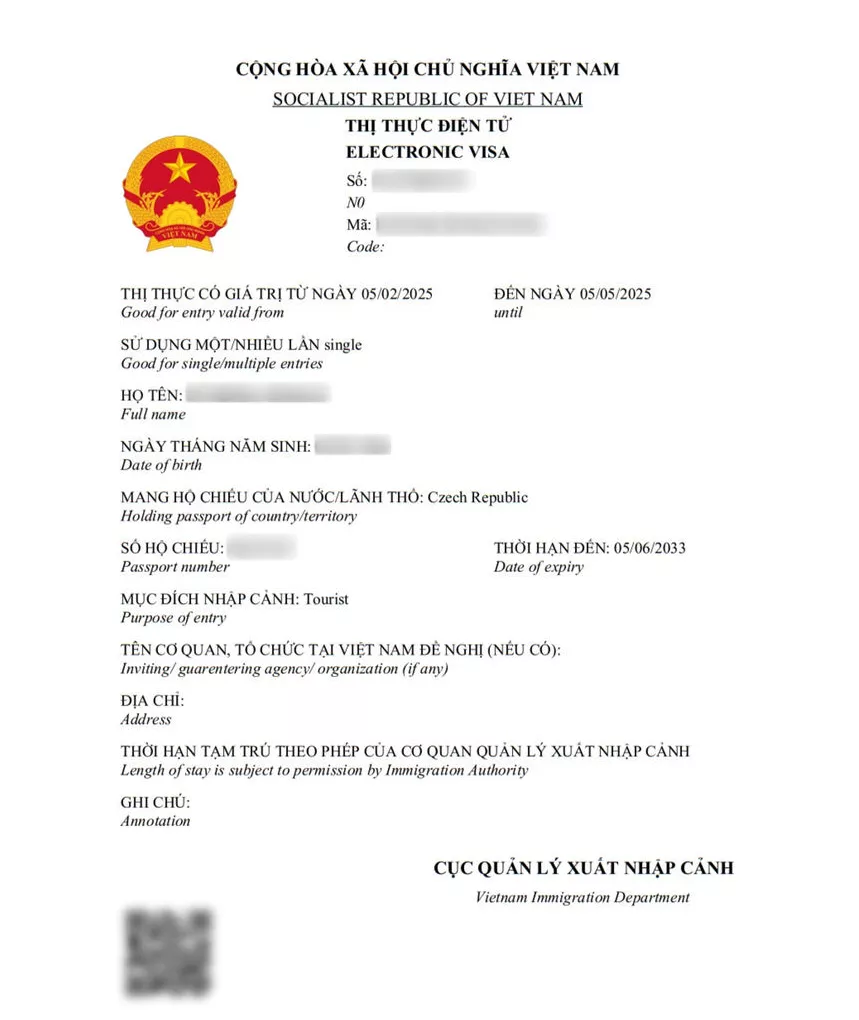
Processing takes approximately 3 business days. You will receive a confirmation email with your e-Visa in PDF format. Print it and carry it with your passport.
Important: If you are already in Vietnam and apply for an e-Visa, you must exit the country and re-enter to activate the new e-Visa. The 90-day count starts from the entry date you specified in your application.
Vietnam e-Visa Entry Points for UK Citizens
The e-Visa is valid at designated ports of entry and exit across Vietnam. Here are the main international airports:
| Airport | City | Code |
|---|---|---|
| Noi Bai International Airport | Hanoi | HAN |
| Tan Son Nhat International Airport | Ho Chi Minh City | SGN |
| Da Nang International Airport | Da Nang | DAD |
| Cam Ranh International Airport | Nha Trang | CXR |
| Cat Bi International Airport | Hai Phong | HPH |
| Phu Quoc International Airport | Phu Quoc | PQC |
| Phu Bai International Airport | Hue | HUI |
| Can Tho International Airport | Can Tho | VCA |
| Van Don International Airport | Quang Ninh | VDO |
| Lien Khuong International Airport | Da Lat | DLI |
The e-Visa is also accepted at numerous land border crossings (with China, Laos, and Cambodia) and sea ports (including Ho Chi Minh City Port, Da Nang Port, Hai Phong Port, and Nha Trang Port). A complete list is available on the official e-Visa portal.
Passport Requirements for UK Citizens
Vietnam has strict passport rules for all visitors. British nationals have been denied entry due to passport damage, so check your document carefully before travelling.
Your passport must meet all of the following conditions:
- Validity: At least 6 months beyond your planned arrival date
- Blank pages: At least 2 blank pages for entry and exit stamps
- Condition: No damage, torn pages, or water damage
- Same passport: You must enter and exit Vietnam using the same passport
If your passport does not meet these requirements, you will be denied entry at the border. British passports reported as lost or stolen will also be rejected.
Dual Nationals
If you hold both British and Vietnamese citizenship, Vietnamese authorities may require you to enter and exit on your Vietnamese passport. When returning to the UK, carry your valid British passport. See GOV.UK guidance on dual citizenship for Vietnam.
Vietnam Digital Arrival Card
From 15 April 2026, all foreign nationals entering Vietnam through Tan Son Nhat Airport (SGN) in Ho Chi Minh City are encouraged to complete a digital arrival card online before arrival.
- Website: prearrival.immigration.gov.vn
- Current status: Encouraged but not yet mandatory
- Future expansion: The system may be rolled out to other Vietnamese airports with limited notice
- Health declaration: From 1 July 2026, you may be required to complete a health declaration, which may include proof of vaccinations
Check with your nearest Vietnamese Embassy for the latest requirements before travelling.
Vietnam Visa Fees for UK Citizens
| Visa Option | Fee | Duration | Entry Type |
|---|---|---|---|
| Visa-free (exemption) | Free | 45 days | Unlimited entries |
| e-Visa (single) | $25 USD | 90 days | Single entry |
| e-Visa (multiple) | $50 USD | 90 days | Multiple entry |
| Visa on Arrival (1 month) | $25 USD stamping fee | 30 days | Single entry |
| Visa on Arrival (3 months) | $50 USD stamping fee | 90 days | Single or multiple |
| Embassy visa (standard) | ~$60-80 USD | Varies | Varies |
| Phu Quoc exemption | Free | 30 days | Single (island only) |
Additional costs to budget for:
- Approval letter (for VOA): $10-20 USD via travel agency
- Passport photos: Bring 2 passport-sized photos (4×6 cm) for VOA
- Travel insurance: Recommended but not currently mandatory
- Yellow fever certificate: Required only if arriving from a country with risk of yellow fever transmission
Visa on Arrival: Detailed Process for UK Citizens
If you choose the Visa on Arrival route, here is the step-by-step process at the airport:
Before departure:
1. Apply for a visa approval letter through a licensed Vietnamese travel agency (takes 2-5 business days)
2. Print the approval letter
3. Prepare 2 passport photos (4×6 cm, white background)
4. Bring USD cash for the stamping fee ($25 for 1 month, $50 for 3 months)
At the Vietnamese airport:
1. Proceed to the “Landing Visa” or “Visa on Arrival” counter before immigration
2. Submit your passport, approval letter, photos, and completed entry/exit form
3. Pay the stamping fee in USD cash (exact amount preferred; change may not be available)
4. Wait for processing (15-45 minutes depending on queue length)
5. Collect your passport with the visa stamp
6. Proceed to immigration control
Important: The VOA is only available at international airports. If you are entering Vietnam by land from Cambodia, Laos, or China, you must have an e-Visa or embassy-issued visa.
Overstay Penalties
Overstaying your visa in Vietnam carries serious consequences:
- Fine: VND 500,000-5,000,000 (~$20-200 USD) depending on duration of overstay
- Deportation: Authorities can deport you and ban you from returning
- Detention: In severe cases, you may be detained pending investigation
- Exit ban: Vietnamese authorities can prevent you from leaving until the fine is paid
- Future entry ban: Overstaying may result in being refused future entry to Vietnam
Always check your visa expiry date stamped in your passport before leaving border control. If the date is incorrect, notify immigration immediately. Once you leave the airport, immigration will not correct it.
Phu Quoc Visa-Free Zone
UK citizens (and all other nationalities) can visit Phu Quoc Island without any visa for up to 30 days, even without the 45-day exemption.
Conditions:
– You must arrive directly from a third country (not from mainland Vietnam)
– You can transit through Hanoi or Ho Chi Minh City airports (clear immigration, proceed to domestic terminal)
– Your stay is restricted to Phu Quoc Island only
– Passport must be valid for at least 6 months from arrival date
If you plan to visit other parts of Vietnam after Phu Quoc, you will need a visa or qualify for the 45-day exemption.
FAQs About Vietnam Visa for UK Citizens
Do UK citizens need a visa for Vietnam?
No, UK citizens with a full British citizen passport can enter Vietnam without a visa for up to 45 days for tourism or business. This exemption has been in place since 1 July 2015. If you plan to stay longer than 45 days, you need to apply for an e-Visa, visa on arrival, or embassy visa before your trip.
How long can UK citizens stay in Vietnam without a visa?
British citizens can stay in Vietnam for up to 45 consecutive days without a visa. The 45-day count starts from your arrival date as stamped in your passport. You can leave and re-enter multiple times during the exemption period, with each entry granting a fresh 45-day stay.
How much is a Vietnam e-Visa for UK citizens?
The Vietnam e-Visa costs $25 USD for single entry or $50 USD for multiple entry. Payment is made online by credit or debit card during the application process on the official portal (evisa.xuatnhapcanh.gov.vn). There are no additional government fees.
How long does it take to get a Vietnam e-Visa?
The standard processing time for a Vietnam e-Visa is approximately 3 business days. During peak travel seasons (December-February, summer months), processing may take slightly longer. Apply at least 1-2 weeks before your travel date to allow for any delays.
Can UK citizens get a Vietnam visa on arrival?
Yes, UK citizens can obtain a Visa on Arrival at Vietnamese international airports, but you must arrange a visa approval letter in advance through a licensed Vietnamese travel agency. The VOA is only available at airports (Hanoi, Ho Chi Minh City, Da Nang, Phu Quoc, Hai Phong, Da Lat, Nha Trang), not at land borders.
What passport validity do I need for Vietnam?
Your British passport must be valid for at least 6 months beyond your planned arrival date in Vietnam. You also need at least 2 blank pages for entry and exit stamps. Passports with damage (torn pages, water damage, missing cover) have resulted in British nationals being denied entry.
Can I extend my stay in Vietnam beyond 45 days?
If you entered visa-free for 45 days, you cannot extend the stay directly. Your options are: (1) leave Vietnam and re-enter for a fresh 45-day period, (2) apply for an e-Visa (90 days) before your trip, or (3) apply for an embassy visa. The British Embassy in Hanoi cannot assist with visa extensions.
Is there a Vietnam digital arrival card for UK citizens?
From April 2026, foreign nationals entering through Tan Son Nhat Airport (Ho Chi Minh City) are encouraged to complete a digital arrival card online at prearrival.immigration.gov.vn before arrival. It is not yet mandatory but may become required. Other airports may adopt the system in the future.
Can I visit Phu Quoc without a visa?
Yes. All nationalities, including UK citizens, can visit Phu Quoc Island without a visa for up to 30 days. You must arrive directly from a third country or transit through Hanoi/Ho Chi Minh City. Your stay is restricted to Phu Quoc only.
What happens if I overstay my Vietnam visa?
Overstaying carries a fine of VND 500,000-5,000,000 (~$20-200 USD), potential detention, deportation, and a future entry ban. Vietnamese authorities may place an exit ban preventing you from leaving until the fine is paid. Always verify the exit date stamped in your passport before leaving border control.
Do I need a transit visa for Vietnam?
If you are transiting by air and do not leave the sterile transit area, you do not need a visa for stays under 24 hours. However, if you transfer from an international to a domestic flight in Hanoi or Ho Chi Minh City, you must clear immigration and enter Vietnam. In that case, the 45-day exemption or e-Visa applies.
What currency should I bring for Vietnam visa fees?
The e-Visa fee is paid online by card. For Visa on Arrival, the stamping fee must be paid in US dollars (USD) cash at the airport. Bring exact amounts ($25 or $50) as change may not be available. Vietnamese dong (VND) is also accepted for the stamping fee but USD is preferred.