
Yes, most travelers need a visa to enter Vietnam. However, citizens of 25+ countries enjoy visa-free entry for 14-45 days, and an electronic visa (eVisa) is available to citizens of all nationalities for stays up to 90 days. This guide covers every requirement you need to know before traveling to Vietnam in 2026.
Passport Requirements for Vietnam
Before applying for any type of Vietnam visa, make sure your passport meets these mandatory conditions:
- Validity: Your passport must be valid for at least 6 months beyond your date of arrival in Vietnam.
- Blank pages: You need at least 2 blank pages for entry and exit stamps.
- No damage: Vietnamese immigration officers have denied entry to travelers with damaged passports. Check your passport well before departure.
- Same passport for entry and exit: You must enter and exit Vietnam using the same passport. Dual nationals should be aware of this rule.
If your passport does not meet these requirements, you will be denied boarding or refused entry at the border.
Digital Arrival Card (New in 2026)
As of April 15, 2026, foreign nationals entering Vietnam via Tan Son Nhat Airport (SGN) in Ho Chi Minh City are encouraged to complete a digital arrival card online before arrival. This system is not yet mandatory but may become required with little notice. It is also expected to roll out to other Vietnamese airports. Check the latest updates from your nearest Vietnamese embassy before traveling.
Vietnam Visa Options at a Glance
There are four main ways to enter Vietnam legally. The right option depends on your nationality, length of stay, and purpose of travel.
| Visa Type | Duration | Entries | Cost (USD) | Who Can Apply |
|---|---|---|---|---|
| Visa Exemption | 14-45 days | N/A | Free | Citizens of 25+ exempt countries |
| eVisa | Up to 90 days | Single or multiple | $25-$50 | Citizens of all countries |
| Visa on Arrival (VOA) | 30-90 days | Single or multiple | $25-$50 + stamping fee | By pre-arrangement only |
| Embassy Visa | Varies | Varies | Varies | All nationalities |
For most travelers, the eVisa is the simplest and fastest option. You can learn more about the full eVisa application process in our step-by-step guide.
Vietnam eVisa Requirements
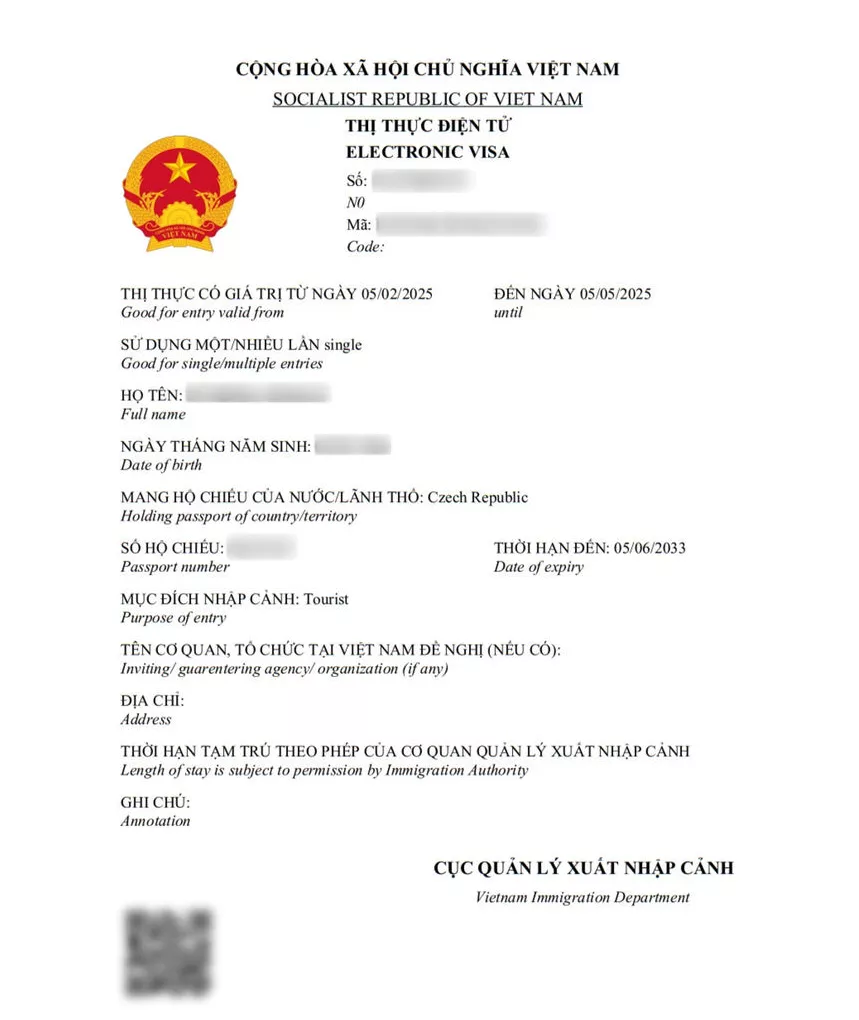
The Vietnam eVisa is available to citizens of all countries and territories since August 15, 2023. Here is what you need:
- A valid passport with at least 6 months remaining validity
- A digital passport photo (4×6 cm, white background, no glasses)
- A scanned copy of your passport data page
- A working email address to receive the eVisa
- A credit or debit card to pay the fee online
- Your intended entry and exit points (must match one of the 42 designated border gates)
eVisa Duration and Validity
- Maximum stay: 90 days
- Entry type: Single entry ($25) or multiple entry ($50)
- Processing time: Typically 3 working days
- Designated entry points: 13 international airports, 16 land border gates, and 13 sea border gates
Important: You must enter and exit Vietnam through the specific border checkpoint listed on your eVisa application. If your plans change, you will need to apply for a new eVisa. For details on fees and processing, see our Vietnam eVisa fee guide.
Official eVisa Portal
The official Vietnam eVisa portal operates at evisa.gov.vn (and thithucdientu.gov.vn). Always apply through these official government domains. Third-party websites may charge extra service fees or collect your personal data unnecessarily.
Vietnam Visa Exemption
Citizens of certain countries do not need a visa for short stays in Vietnam. Since August 2023, the exemption period was extended to 45 days for 13 countries under unilateral agreements.
Countries with Unilateral Visa Exemption (45 days)
Germany, France, Italy, Spain, United Kingdom, Russia, Japan, South Korea, Denmark, Sweden, Norway, Finland, and Belarus.
ASEAN and Bilateral Visa Exemptions (14-30 days)
Brunei, Myanmar, Philippines, Cambodia, Indonesia, Laos, Malaysia, Singapore, Thailand, Kyrgyzstan, Chile, and Panama.
Important Exemption Notes
- The 45-day exemption applies regardless of passport type and entry purpose.
- If you want to stay longer than the exemption period, you must apply for an eVisa or embassy visa before your exemption expires.
- Overstaying your exemption period results in fines and possible deportation.
- US citizens are not on the visa exemption list and must obtain an eVisa or visa before travel.
For a complete breakdown by country, visit our Vietnam visa exemption guide.
Visa on Arrival (VOA)
Vietnam Visa on Arrival is available but only under specific conditions:
- You are departing from a country with no Vietnamese diplomatic mission
- You are traveling through multiple countries before arriving in Vietnam
- You have a specific emergency or humanitarian reason
Unlike many countries, Vietnam’s VOA requires pre-arrangement through a licensed travel agency. You cannot simply show up at the airport and get a visa. The agency obtains an approval letter from the Vietnamese Immigration Department, which you present at the VOA counter upon arrival.
For most travelers, the eVisa is a better option because it is cheaper, simpler, and does not require a third-party agent. Compare all options in our Vietnam visa types guide.
Documents Required for Vietnam Entry
When you arrive in Vietnam, immigration officers may ask to see the following:
| Document | Required? | Notes |
|---|---|---|
| Valid passport | Yes | 6+ months validity, 2 blank pages |
| Visa or eVisa printout | Yes (unless exempt) | Print your eVisa approval or have it on your phone |
| Return/onward ticket | Recommended | Officers may ask for proof of onward travel |
| Hotel booking confirmation | Recommended | Especially for first-time visitors |
| Proof of sufficient funds | Occasionally requested | Bank statements or cash |
| Digital arrival card | Encouraged | Complete online before arrival at SGN airport |
| Travel insurance | Recommended | Not mandatory but strongly advised |
Vietnam Visa Cost Summary
| Visa Type | Government Fee | Additional Costs |
|---|---|---|
| eVisa (single entry) | $25 USD | None |
| eVisa (multiple entry) | $50 USD | None |
| Visa on Arrival | $25-$50 USD | Stamping fee: $25 (single) / $50 (multiple) at airport |
| Embassy Visa | $60-$100+ USD | Varies by embassy and visa type |
| Visa Exemption | Free | None |
The eVisa is the most cost-effective option for most travelers. There are no hidden fees when you apply through the official government portal. For a detailed cost breakdown, see our complete fee guide.
Health and Vaccination Requirements
Vietnam does not currently require COVID-19 vaccination proof or PCR tests for entry. However, travelers should:
- Be up-to-date on routine vaccinations
- Consider vaccines for hepatitis A, hepatitis B, rabies, Japanese encephalitis, and typhoid
- Carry prescription medication in hand luggage with a copy of the prescription
- Have valid travel insurance that covers medical evacuation
If you carry prescription medication valued over $100 USD, you must declare it at customs.
Customs Rules and Cash Declaration
Vietnam has strict customs rules. You must declare:
- Cash amounts exceeding 15 million Vietnamese dong or $5,000 USD (or equivalent in other currencies)
- Prescription medication with import value over $100 USD
- Any goods that may be prohibited or subject to duty
Failure to declare can result in fines or confiscation of goods.
Common Mistakes to Avoid
- Applying through unofficial websites: Many third-party sites charge $80-$150 for eVisa services that cost only $25-$50 on the official portal.
- Entering through the wrong border gate: Your eVisa is only valid at the checkpoint you selected during application.
- Overstaying your visa or exemption: Overstaying results in fines of approximately $25-$50 per day and possible deportation.
- Insufficient passport validity: Even if your passport expires 5 months after arrival, you will be denied entry.
- Not printing the eVisa: While some checkpoints accept digital copies, carrying a printed copy is strongly recommended.
- Confusing visa exemption with visa-free entry: The exemption has a strict time limit. Exceeding it without a valid visa is illegal.
FAQs About Vietnam Visa Requirements
Do I need a visa for 20 days in Vietnam?
It depends on your nationality. Citizens of 25+ countries (including the UK, Germany, France, Japan, and South Korea) can stay visa-free for up to 45 days. US citizens and most other nationalities need an eVisa, which is easy to obtain online for $25.
Do US citizens need a visa for Vietnam?
Yes. US citizens are not on the Vietnam visa exemption list. The easiest option is the eVisa ($25 for single entry, $50 for multiple entry), which allows stays of up to 90 days. Apply through the official portal at evisa.gov.vn.
How much is a Vietnam visa for US citizens?
The official eVisa fee is $25 USD for a single-entry visa or $50 USD for a multiple-entry visa. There are no additional government charges. Avoid third-party websites that charge $80 or more for the same service.
Is it difficult to get a Vietnam visa?
No. The eVisa application process is straightforward and takes about 10-15 minutes online. Most applications are approved within 3 working days. You need a valid passport, a digital photo, and a payment card.
Can I get a Vietnam visa at the airport?
Visa on Arrival (VOA) is available but requires pre-arrangement through a licensed travel agency before you fly. You cannot get a visa by simply arriving at the airport. The eVisa is a simpler and cheaper alternative for most travelers.
Which countries are visa-free for Vietnam?
25 countries plus Kazakhstan enjoy visa-free entry. The 13 countries with 45-day unilateral exemption are Germany, France, Italy, Spain, UK, Russia, Japan, South Korea, Denmark, Sweden, Norway, Finland, and Belarus. ASEAN members and several other nations have 14-30 day exemptions.
How long does a Vietnam eVisa take to process?
The standard processing time is 3 working days. During peak travel seasons, it may take slightly longer. Apply at least 1-2 weeks before your trip to allow for any delays.
Can I extend my Vietnam eVisa?
No, the eVisa cannot be extended. If you want to stay longer than 90 days, you must leave Vietnam and apply for a new eVisa, or apply for a different visa type through the Vietnamese embassy before your trip.