Vietnam offers multiple visa types to suit different travel purposes – from the popular 90-day e-Visa and visa-free exemptions to business (DN), work (LD), and investor (DT) categories. Understanding which visa type matches your trip purpose is essential for a smooth entry. This guide covers every Vietnam visa category, validity period, cost, and how to apply.
Vietnam Visa Types at a Glance
Vietnam classifies visas by both purpose of visit and validity/entry type. Under the amended Immigration Law (Law No. 51/2019/QH14, effective July 1, 2020, with further updates in 2023), there are over 20 designated visa codes. Below is a quick overview of the most common types.
| Visa Type | Code | Purpose | Max Validity |
|---|---|---|---|
| Tourist | DL | Leisure travel and sightseeing | 90 days |
| Business | DN1 / DN2 | Business meetings, trade, services | Up to 1 year |
| Work | LD1 / LD2 | Employment with a Vietnamese employer | Up to 2 years |
| Investor | DT1-DT4 | Foreign investment in Vietnam | Up to 5 years |
| Student / Internship | DH | Study or internship programs | Duration of program |
| Diplomatic | NG | Diplomatic or consular duties | Up to 12 months |
| Transit | – | Passing through Vietnam en route to another country | Up to 5 days |
| Visa Exemption | – | Visa-free entry for eligible nationalities | 15-45 days |
| e-Visa | EV | Online electronic visa for tourism or business | 90 days |
Vietnam e-Visa (Electronic Visa)
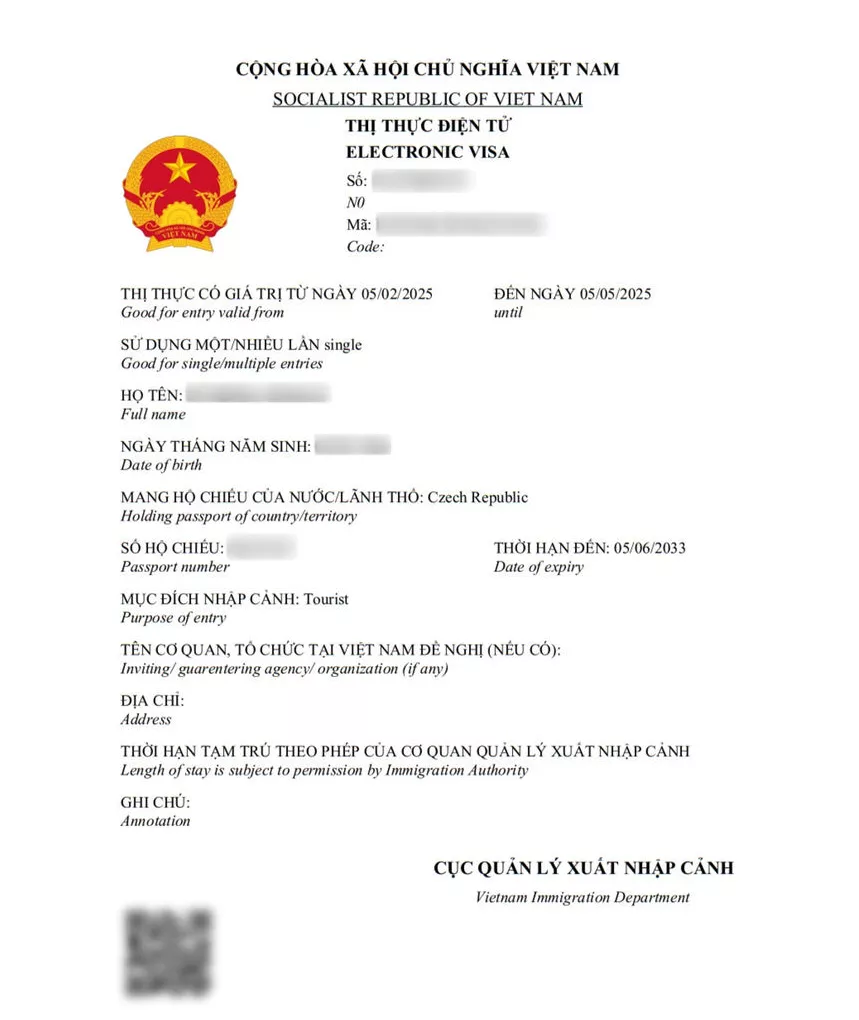
The e-Visa is the most popular entry method for short-term visitors. Available to citizens of all nationalities, it allows stays of up to 90 days for single or multiple entries.
Key details:
- Cost: $25 USD (single entry) or $50 USD (multiple entry)
- Validity: Up to 90 days from the date of entry specified in the application
- Entry points: 42 international checkpoints (airports, land borders, and seaports)
- Processing time: 3 working days (standard)
- How to apply: Online at the official government portal
For a complete walkthrough, see our Vietnam eVisa Application Guide. You can also check our guide to Vietnam eVisa fees for the latest pricing.
e-Visa vs Visa on Arrival
Many travelers confuse the e-Visa with the Visa on Arrival (VOA). The key difference is that the e-Visa is obtained entirely online before departure, while the VOA requires a pre-arranged approval letter and visa stamping at the airport upon arrival. The e-Visa is generally cheaper, faster, and does not require an intermediary agency. For a detailed comparison, see our Vietnam Visa on Arrival guide.
Vietnam Visa Exemption
Citizens of certain countries can enter Vietnam without a visa for short stays. The exemption duration depends on nationality:
| Nationality | Exemption Duration |
|---|---|
| ASEAN member states | 30 days |
| South Korea, Japan | 45 days |
| Germany, France, Italy, Spain, UK, Sweden, Norway, Denmark, Finland, Belarus | 45 days |
| Russia | 45 days |
| Chile | 90 days |
| Panama | 90 days |
| Mongolia | 30 days |
The exemption periods were extended from 15 days to 45 days for several European countries and Japan in August 2023. Travelers who wish to stay longer than the exemption period must apply for an appropriate visa.
Important: Visa exemption is not the same as a visa. If you overstay the exemption period, you will face fines and potential entry bans. See our Vietnam Visa Exemption guide for the full list of eligible countries and conditions.
Tourist Visa (DL)
The Tourist visa (code DL) is the standard visa for leisure travelers. It comes in several forms depending on how you apply:
Via e-Visa: Up to 90 days, single or multiple entry, $25-$50. This is the easiest route for most tourists.
Via Embassy/Consulate: You can apply at a Vietnamese embassy or consulate in your home country. Processing typically takes 5-7 business days. Fees vary by embassy and visa type (single vs. multiple entry, 30 vs. 90 days).
Via Visa on Arrival: Available only for air travelers. You obtain an approval letter from a licensed travel agency (5-7 days, $6-$25 service fee), then get your visa stamped at the airport upon arrival (stamping fee $25-$50 cash). For step-by-step details, see our Vietnam Visa on Arrival guide.
Tourist Visa Options Compared
| Application Method | Cost (approx.) | Validity | Processing Time | Best For |
|---|---|---|---|---|
| e-Visa | $25 single / $50 multiple | Up to 90 days | 3 working days | Most travelers |
| Embassy | $50-$100+ | 30-90 days | 5-7 business days | Long stays, non-e-Visa nationalities |
| Visa on Arrival | $6-$25 service + $25-$50 stamp | 30-90 days | 5-7 days (letter) + airport | Air travelers only |
Business Visa (DN1, DN2)
The Business visa is for foreigners visiting Vietnam for commercial purposes. It is coded as:
- DN1: For those working with Vietnamese companies or organizations that have legal status in Vietnam
- DN2: For those providing services or establishing a commercial presence in Vietnam
Business visas are available as single or multiple entry, with validity ranging from 1 month to 1 year. A business visa does not authorize employment – for that, you need a Work visa (LD).
How to apply: Business visas can be obtained through a Vietnamese embassy, via visa on arrival (with an approval letter from a Vietnamese sponsor), or as a 30-day e-Visa for short business trips.
For more details, see our Vietnam Business Visa guide.
Work Visa (LD1, LD2)
Foreigners employed in Vietnam must hold a Work visa. The two sub-types are:
- LD1: For foreign workers with a work permit or work permit exemption certificate
- LD2: For foreign workers who are not eligible for a work permit but are approved by a provincial people’s committee
Work visas are valid for up to 2 years and require sponsorship from a Vietnamese employer. The employer initiates the process by obtaining a work permit on your behalf before you can apply for the visa.
Investor Visa (DT1-DT4)
Foreign investors in Vietnam can obtain long-term visas based on the size and type of their investment:
| Visa Code | Investment Type | Max Validity |
|---|---|---|
| DT1 | Foreign investment in encouraged sectors with capital contribution of VND 100 billion+ | Up to 5 years |
| DT2 | Foreign investment in encouraged sectors with capital contribution of VND 50-100 billion | Up to 5 years |
| DT3 | Foreign investment with capital contribution of VND 3-50 billion | Up to 3 years |
| DT4 | Foreign investment with capital contribution under VND 3 billion | Up to 1 year |
Investor visas allow multiple entries and can be renewed. They also provide a pathway to temporary residence cards.
Student Visa (DH)
The Student/Internship visa (code DH) is issued to foreigners enrolled in Vietnamese educational institutions or participating in internship programs. It is valid for the duration of the study program and requires sponsorship from the educational institution.
Diplomatic and Official Visas
Diplomatic visas (NG) are issued to foreign diplomats and government officials on official duty in Vietnam. Additional codes cover delegations invited by Vietnamese government officials (NN1, NN2, NN3), and journalists (PV1, PV2). These visas typically do not require a fee and are processed through diplomatic channels.
Transit Visa
Travelers passing through Vietnam on their way to another country may need a transit visa depending on their nationality and the length of their layover. Transit visas allow stays of up to 5 days and require proof of onward travel.
Exemptions: Most travelers with connecting flights who stay in the international transit area of Vietnamese airports do not need a transit visa. However, if you plan to leave the airport or your layover exceeds the allowed transit time, you will need a visa or valid exemption.
Vietnam Visa Types by Validity and Entry
Beyond purpose-based classification, Vietnam visas are also categorized by how long they are valid and how many times you can enter:
| Validity | Entry Type | Typical Use |
|---|---|---|
| 30 days | Single or Multiple | Short business trips, tourism |
| 90 days | Single or Multiple | Extended tourism, short-term projects |
| 6 months | Multiple | Frequent business travelers |
| 1 year | Multiple | Long-term business, work visa holders |
| 2 years | Multiple | Work permit holders |
| 5 years | Multiple | Investors, lawyers |
Single entry means you can enter Vietnam once during the visa validity period. Multiple entry means you can enter and exit Vietnam as many times as you want during the validity period – essential for travelers who plan to visit neighboring countries and return.
Which Vietnam Visa Do You Need?
Use this quick decision guide to determine the right visa type for your trip:
- Tourism for up to 90 days: Apply for an e-Visa ($25-$50)
- Visiting from a visa-exempt country for up to 45 days: No visa needed (check exemption list)
- Business meetings or conferences for up to 90 days: e-Visa covers business purposes too
- Working in Vietnam: Your employer must arrange a Work visa (LD1/LD2)
- Investing in Vietnam: Apply for an Investor visa (DT1-DT4) based on investment size
- Studying in Vietnam: Your school sponsors a Student visa (DH)
- US citizens specifically: See our dedicated Vietnam Visa for US Citizens guide
How to Change or Extend Your Visa Type in Vietnam
Changing your visa type while in Vietnam is possible but requires visiting an immigration office. Common scenarios include:
- Extension: Extend your current visa at the Immigration Department in Hanoi, Da Nang, or Ho Chi Minh City. Fees and processing times vary.
- Type change: Converting from a tourist visa to a work visa, for example, requires employer sponsorship and a new work permit application.
- Overstay: If you overstay your visa or exemption period, you will face fines (typically VND 500,000-VND 20,000,000 depending on the length of overstay) and may be banned from re-entering Vietnam.
Contact information for Immigration Offices:
- Hanoi: 69 Mac Thai To Street, Yen Hoa Ward – Phone: 024 3825-7941
- Da Nang: 78 Le Loi, Hai Chau – Phone: 069 426 0192
- Ho Chi Minh City: 196 Nguyen Thi Minh Khai, Xuan Hoa Ward – Phone: 028 3829-9398
FAQs About Vietnam Visa Types
What are the 6 main types of Vietnam visa?
The six most common Vietnam visa types are: Tourist visa (DL), Business visa (DN1/DN2), Work visa (LD1/LD2), Student visa (DH), Investor visa (DT1-DT4), and Diplomatic visa (NG). Each serves a distinct purpose and has different validity and application requirements.
What is the difference between an e-Visa and a Visa on Arrival in Vietnam?
The e-Visa is applied for and obtained entirely online before your trip, costs $25 (single) or $50 (multiple), and is valid for up to 90 days. A Visa on Arrival requires a pre-approved approval letter from a travel agency and is stamped at the airport. The e-Visa is cheaper, faster, and available for both air and land entry.
Which 12 countries are visa-free for Vietnam?
Vietnam offers visa exemptions to citizens of many countries, not just 12. ASEAN nationals get 30 days, while citizens of South Korea, Japan, Russia, and several European countries (Germany, France, Italy, Spain, UK, Sweden, Norway, Denmark, Finland, Belarus) get 45 days. Chile, Panama, and Mongolia also have exemptions. The full list was updated in August 2023.
How much is a Vietnam e-Visa for US citizens?
US citizens pay $25 USD for a single-entry e-Visa or $50 USD for a multiple-entry e-Visa. Applications are submitted online at evisa.gov.vn. The visa is valid for up to 90 days. For more details, see our Vietnam Visa for US Citizens guide.
How do I get a 1-year visa for Vietnam?
A 1-year visa is available for Business (DN), Work (LD), or Investor (DT) visa holders. Tourist and e-Visas are limited to 90 days maximum. To obtain a 1-year visa, you typically need a Vietnamese sponsor (employer or business partner) to initiate the application through immigration authorities.
Can I get a Vietnam visa online?
Yes. The e-Visa is available entirely online at evisa.gov.vn for citizens of all nationalities. It costs $25 for a single entry and $50 for a multiple entry, valid for up to 90 days. Processing takes approximately 3 working days.
Do US citizens need a visa for Vietnam?
Yes, US citizens need a visa to enter Vietnam. They are not eligible for the visa exemption program. The easiest option is the e-Visa ($25-$50, up to 90 days), which can be applied for online. US citizens can also apply at the Vietnamese embassy or use Visa on Arrival when flying into Vietnam.
Is it difficult to get a Vietnam visa?
No. For most travelers, getting a Vietnam visa is straightforward. The e-Visa application takes about 15 minutes online, costs $25, and is typically approved within 3 working days. Citizens of exempt countries do not need a visa at all for stays up to 45 days.
What is the cheapest way to get a Vietnam visa?
The cheapest option is the e-Visa at $25 USD for a single entry, applied for directly at evisa.gov.vn without any third-party agency fees. Citizens of visa-exempt countries pay nothing for stays up to 30-45 days. Avoid unofficial websites that charge inflated service fees.
Can I change my visa type while in Vietnam?
Yes, but it requires visiting an Immigration Office and may need additional documentation. For example, converting a tourist visa to a work visa requires employer sponsorship and a valid work permit. Contact the nearest Immigration Office for current procedures and fees.